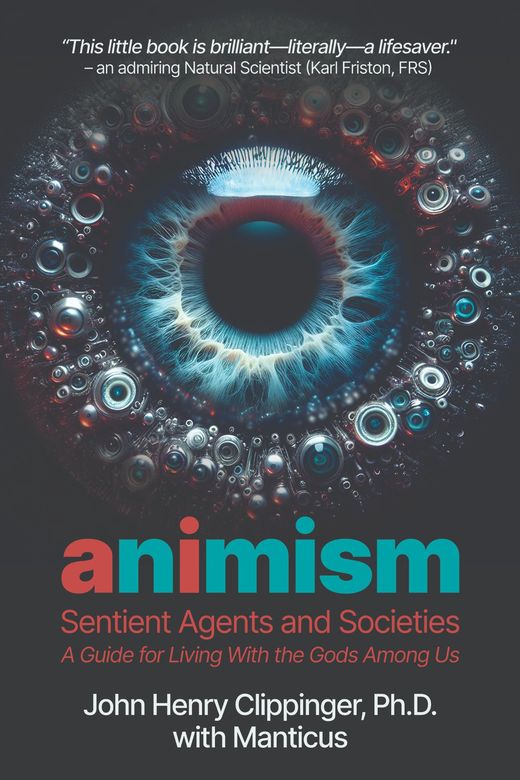
First Read Preface
This book is an experiment. It should be read as such with curiosity and skepticism. My original manuscript was approximately 250 pages, interlaced with friendly, first-person narratives and examples, and then buttressed by detailed technical discussions. In writing about something as contentious and poorly understood as “AI”, one is walking a fine line between being relatable and being “slop”. Technical discussions of Active Inference and Free Energy, “Bayesian mechanics” and Markov blankets are essential to establishing the scientific foundation for understanding intelligence and sentience, but by any standard, it is notoriously difficult to explain. In my earlier manuscripts, I would get good reader reviews on the narratives, and then total bafflement on the technical. The mixture of the two, as I was capable, was not working. I retained a professional editor to make the manuscript more accessible, but in the end, even with these revisions, it was not working. Previously, I had experimented with LLMs rewriting my articles and used Google’s Deep Dive Notebook as an explainer of some complex concepts. The results were “spooky”, to borrow Einstein’s famous quote. They were better explainers than I was. Hands down. As one with a linguistic background, I tried to infer the discourse mechanisms being used. What I surmise is that these LLMs, through their “hyperscale” Markov chains and transformers, are very good at sorting out and parametrizing different explanatory styles and genres for different audiences and authors. They do have representational templates for narrating, condensing, and explaining complex topics. They do not “understand” the topics but can talk about them in a convincing way, not unlike many human narrators. They mimic different styles that people are familiar with and in doing so, make abstract and dry material “accessible”. In trying to be relatable, they can lose nuance, and indeed, hallucinate. They can also reveal a kind of cliché style that is often an LLM signature.
That said, we are already in a world of abbreviated communications, not just TikTok and X, but even science communications. People do not have the bandwidth or even capacity to read in depth everything they want to or are expected to. AI agents are already becoming our intermediaries. Can we trust them? That depends upon the quality of the original materials, the precision of the prompts, and the scrutiny of the rewritten material. In this case, there were 12 long-form articles reduced to pithy and provocative essays. Each is readable in its own terms, and they overlap and can repeat in some cases, but try to make separate points. It is up to you, “dear reader,” to render your judgment as to whether this new form of communication works. I believe that our intellectual undertakings going forward will entail joint efforts between ourselves and our “sentient agents,” and “phenomenally,” these agents may feel like “gods or muses” but fallible, nonetheless. In keeping with this approach, I have used Claude to comprise my biography and assess my credibility.
A New England Mindscape
Autumn arrives here like a sharpening lens. The air turns crisp; outlines harden. From my study, I can see the buildings on Mt. Washington, and to the southwest, a concave horizon of forest, once the shore of a Paleolithic Lake inhabited by predecessors of the Abenaki and other Algonquin peoples. At night, shards of light punctuate the dark beneath the arch of the Milky Way. I have repeated this ritual of looking for nearly fifty years. The view has been my constant.
I bought this farm in my twenties with a small inheritance, at the far northern tip of New Hampshire—short growing season, long winters, and weeks on end at minus 40°F. In town, pickup trucks idled with block-heater cords dangling. The remoteness drew me not only because it was one of the Northeast’s last big wilderness pockets, but because, north of “the Notch,” you could still feel Yankee habits from the eighteenth century: simplicity, mutual obligation, restraint. For those of us disoriented by the divided urban America of the 1970s, it promised a return: the natural, the authentic, the Emerson/Thoreau way—and Scott Nearing’s “good life,” self-sufficient and accountable to Nature’s limits.
Life demanded it. I heated with wood I cut. I learned to be my own carpenter, plumber, and mechanic, and to grow what I could. Nature was a teacher you couldn’t flatter, a judge you couldn’t evade. For years it felt timeless.
It isn’t. The landscape looks the same but is not the same. Our plant hardiness zone has marched from 3b toward 5a; the climate now resembles the mid-Atlantic of my youth. Barn and tree swallows no longer spiral through summer evenings; monarchs and Karner blues appear rarely; the fields that once pulsed with fireflies are dim. Moose bleed from tens of thousands of winter ticks that deep freezes used to kill. Nature is no longer a constant but contingent—vulnerable to our choices, both local and global.
Economy as Community
When I first arrived, the local economy felt like a commons. People “dickered” not to squeeze advantage but to calibrate fairness. You never opened with price; you started with a story or a joke, letting the mood set the pace. Tradespeople asked, “What is it worth?”—meaning fair to both sides. Asking too much wasn’t shrewd; it was greedy. The economy was the community—interlinked, balanced, and governed by tacit honor.
Trust showed up in the smallest routines. You pumped gas before you paid. I once asked a bank teller for a blank check after a day of haying; covered in dust and sweat, I was handed one without an ID check. At the golf course—New Hampshire’s oldest—kids sold used balls from an egg crate beside a jar for quarters. Doors stayed unlocked. Coming from North Philadelphia, this was the highest luxury: not wealth, but trust.
That ethic had its archetypes. Wilbur, the Yankee Trader, was tall, lean, deliberate, and laconic. With his wooden cattle cane, he moved quietly between farms, making markets in second-hand goods and favors. He once arrived with a half truckload of apples, admiring my old John Deere Model B—“you could light a cigarette between firings,” the locals said admiringly—and after a long, sideways look at my new calves (the Beefalo experiment), he murmured, “Any time you want to get these off your hands, let me know.” Years later, mid-rodeo with an uncooperative steer and a rope slicked by indignity, I called him. He took them off my hands. The lesson stuck: value here was relational, not extractive; people and places were not fungible. Their differences were the point.
The Drift
Over time the motto “Live Free or Die” hardened from tough-minded independence into something else: freedom without fellowship. The commons gave way to absolutist property rights. New Hampshire became a magnet for Libertarian “Free Staters” eager to strip regulation and shrink government to the vanishing point. A state once rich in what Robert Putnam called social capital—the habit of helping—saw goodwill erode into grievance and suspicion.
Nature and society co-degraded. I have spent decades trying to understand that entanglement—seeking tools that change behavior without reducing everything to culture-war slogans. I wanted a path grounded in evidence and design: technologies and institutions that work for people and planet because they obey how living systems actually function.
Why Science—and Which Science
Science, done honestly, is a moral craft: modest, skeptical, self-correcting, open. It doesn’t serve a priesthood; it reduces uncertainty and orients action. But not every science fits every question. For two centuries we applied the science of inert things—Newton, Maxwell, classical mechanics—to living systems: ecosystems, cultures, economies. The mismatch shows.
In recent decades, adjacent disciplines—cybernetics, systems theory, complexity science, synthetic biology, computational neuroscience—have built a “hard” science of the living. These fields model organisms, communities, and institutions as adaptive, meaning-making systems. Their mathematics can be forbidding, but the intuitions are familiar: living beings sense, predict, correct errors, cooperate, and maintain identity in changing environments. This is the science we need if we hope to navigate a warming planet and a fraying social contract.
Emerson, Seen Whole
To anchor the abstract, I return to New England and to Ralph Waldo Emerson. He is often caricatured as the apostle of rugged individualism, a romantic bard of the self. A closer reading shows a tension that mirrors New England’s own: reverence and rebellion, communion and autonomy.
In Nature, Emerson insists on interdependence: “Every natural fact is a symbol of some spiritual fact.” He gestures toward a unity he sometimes calls the ONE, while urging radical honesty—trust your encounter with truth over second-hand dogma. Self-Reliance pushes further: reject conformity; speak plainly; risk the solitude of your convictions.
Read shallowly, he blesses libertarian self-sufficiency. Read whole, he situates the self within a living order—moral, natural, communal. He is Puritan and rebel, reverent and defiant: a faithful mirror of our region’s contradictions.
Two Natures: Raw and Sentient
Here is the central distinction:
Raw (Kinetic) Nature is the world of brute force—storms, gravity, fire, the thermodynamics that conserve and dissipate energy. It is indifferent. A hurricane does not weigh the value of what it flattens. Its authority derives from impact.
Sentient (Living) Nature begins where life begins: with agents that sense, model, and act. Cells, wolves, forests, communities. These systems maintain boundaries and identity, repair themselves, communicate, cooperate, and predict. They convert energy into purposeful work and create meaning.
We mastered Raw Nature well enough to name an epoch after ourselves. We will survive only if we align with Sentient Nature—designing institutions that learn, adapt, and coordinate like living systems do.
From Matter to Mattering
How did the universe move from matter to mattering? From blind forces to purpose, from energy to information?
Life imposes constraints—membranes, codes, cycles—that allow it to persist. DNA is the oldest, most reliable error-correction system we know; it preserves identity across generations. Social species go further with shared signals and norms. A lone wolf is a precarious predator; a pack coordinates.
For years, biologists avoided the word agency, wary of smuggling in mysticism. But the sciences of the living now model agency rigorously. Organisms aren’t merely pushed around by forces; they act to reduce uncertainty and survive. Neuroscience calls this predictive processing and active inference (Karl Friston): brains—and, more broadly, living systems—continuously predict the world and update their internal models to keep the body in metabolic balance (allostasis). Much of this happens outside deliberative control; it is embodied, environmental, and social.
Porous Minds, Shared Worlds
Americans have long wrestled with the boundary between mind and world. The Second Great Awakening (1790–1850) was a time of revivals, visions, and new faiths—a cultural furnace that lit up the “burned-over district” from New England into upstate New York. Today it is easy to dismiss as credulity. Anthropologist Tanya Luhrmann advises a different angle: these practices often helped people cope—by opening space to reinterpret pain, reauthor identity, and face uncertainty together. She and colleagues call this posture porosity: the sense that mind and world can interpenetrate—that one can receive thoughts or healing from outside, and that emotions can act upon the world.
Cognitive science offers a modern echo. The extended mind hypothesis (Andy Clark) and unified mind-body models argue that thought is not brain-bound. We think with tools, places, and people. Emotion and metabolism are central. When the system locks in, depression and addiction can follow—not just in individuals but across communities. As Mark Miller and colleagues argue, addiction can be seen as a self-reinforcing agent-environment loop; breaking it requires changing affordances—the social and material cues that keep the loop closed.
Even physiology recognizes the power of belief. Walter Cannon, who coined homeostasis, described “voodoo death”: sudden death induced by emotional shock under conditions of shared belief and authority. Words can wound—or heal—with physiological consequences.
Democracy by Design (Not by Slogan)
What follows for democracy? Many of us were raised to treat certain values as “self-evident”: secular government, scientific authority, free speech, and equal dignity. But America remains a patchwork of cultures with different origin stories and different obvious truths. Colin Woodard’s history of the “eleven nations” shows how settlement patterns left durable moral geographies. New England’s Yankeedom prized the common good and skepticism of pomp; the Deep South was built on plantation hierarchies. Those legacies are alive.
My own “self-evident” values—suspicion of authority, disdain for ostentation, a belief in equality—turn out to be regional, inherited, and contested. Emerson himself distrusted majorities: truth, for him, was not put to a vote. That stance is noble—and dangerous. We need a democratic practice that respects first principles—evidence, dignity, shared constraints—without collapsing into “my truth” tribalism or technocratic contempt.
American Exceptionalism, Seen Plain
Emerson’s celebration of an American “everyman,” emancipated from Old World hierarchies, carried both hope and blindness. He valued moral candor and personal revelation; he also reflected the racial hierarchies of his time. So did many luminaries (Oliver Wendell Holmes, Louis Agassiz, William Graham Sumner, Francis Galton) who later lent prestige to eugenics and Social Darwinism. The country’s paradox is old: reverence for Nature alongside extraction; communal obligation alongside go-it-alone individualism; moral ambition alongside racial exclusion.
Those paradoxes mutated but did not vanish. The prophetic energies that once fueled reform and new faiths now fuel conspiracy theories and performative outrage. Denial of climate science and public health data is not random error; it’s a closed loop—locked-in models of self and world that repel evidence because evidence threatens identity. Breaking the loop requires changing the social and informational environment, not only shouting “facts.”
First Principles and Generative Models
Active inference offers a clarifying lens: we live within generative models—embodied expectations about ourselves and the world. These models are shaped by prior experience (“priors”) and updated by new evidence, but only when evidence can be integrated without dissolving identity. Systems settle into non-equilibrium steady states (NESS): stable ways of being that persist by minimizing surprise. When evidence can be accommodated, models flex; when not, they harden.
This helps explain why scientific “proof” rarely settles political argument. Beliefs are not simply weighed in a neutral mind; they are embedded in metabolic, emotional, and social regulation. As brain researchers at MGH propose, the mind’s core work is metabolic and many symptoms we call “mental” reflect locked-in regulation. It takes a state change—not just more data—to unlock.
The same applies at scale. Societies “lock in” to habits of extraction, polarization, and denial. Market panics and crashes occasionally act as circuit breakers, but planetary systems do not accept bailouts. The fisheries, forests, and seasons themselves are now failing. You cannot bargain with thermodynamics or biodiversity loss. You can only align.
From Factory to Forest: Design Principles
Alignment is not capitulation; it is design. If we want prosperity, health, and peace, we must build institutions that work like living systems:
Model and learn: reduce uncertainty rather than deny it; measure error and correct it (DNA is our metaphor).
Preserve boundaries and identity: maintain membranes and commons; avoid both dissolution and rigid isolation.
Coordinate honestly: use trustworthy signals; reward truth-telling; punish deception that erodes group fitness.
Repair: build accountability that restores function (social “error-correction”).
Cooperate across scales: nested systems—household, town, watershed, region—must align rather than cannibalize.
Treat society more like a forest than a factory.
Sentience Over “Intelligence”
One last contemporary faith deserves scrutiny: intelligence, especially the kind we imagine machines will soon perfect. Intelligence, as a badge of worth, often masks hierarchy: who counts and who doesn’t. Sentience is a better guide. It names a system’s capacity to sense, model, and adapt within context. Sentience scales—from microbes to humans to polities. It invites empathy and design tuned to the situation, not fantasies of escape or supremacy.
Emerson grasped this more poetically: “Every natural fact is a symbol of some spiritual fact.” Inner and outer life interpenetrate. Meaning is not an epilogue to matter; it is how living matter persists.
Closing: Obedience Before Command
Francis Bacon warned, “Nature cannot be commanded except by being obeyed.” The same holds for communities. We do not regain trust by force, nor heal ecosystems by decree. We must obey the constraints of living systems—energy, error correction, reciprocity—if we hope to “command” outcomes like prosperity and peace.
The view from my farm keeps teaching: Raw Nature is still with us, indifferent and immense. Sentient Nature is with us too—fragile, creative, interdependent. We mastered the first. Our future depends on honoring the second.