On Wednesday, Nvidia reported the best quarter in the history of the semiconductor business. Its stock fell anyway. Two days later, OpenAI quietly filed the paperwork to go public at a valuation near a trillion dollars, and the question of the cycle quietly changed.
FNC-1, our index of the companies actually building the AI buildout, held its ground this week while the chip index ran ahead of it. The Belief Index, a read on how convinced the betting markets are that the boom continues, climbed. The two moved in different directions, and the reason they did is the story.
Picture the portfolio manager who spent the spring overweight the chip leader, sitting down Thursday morning to decide whether a record quarter the market shrugged at is a reason to add or a reason to trim. This Reading is for that decision.
I. Capital
Capital did not broaden this week. It concentrated, and it concentrated in the one place that was already crowded.
The week's binding event came Wednesday after the close. Nvidia reported first-quarter revenue of $81.6 billion, up 85% from a year ago, with adjusted earnings of $1.87 a share against a $1.76 consensus, and data-center revenue near $39.1 billion. CEO Jensen Huang said Blackwell sales were “off the charts” and that cloud GPUs were sold out. It was a clean beat on every line that mattered. The stock then fell about 1.8%, having already run up roughly 14% since February's print and trading near thirty times forward earnings. The market had bought the quarter weeks before Nvidia reported it.
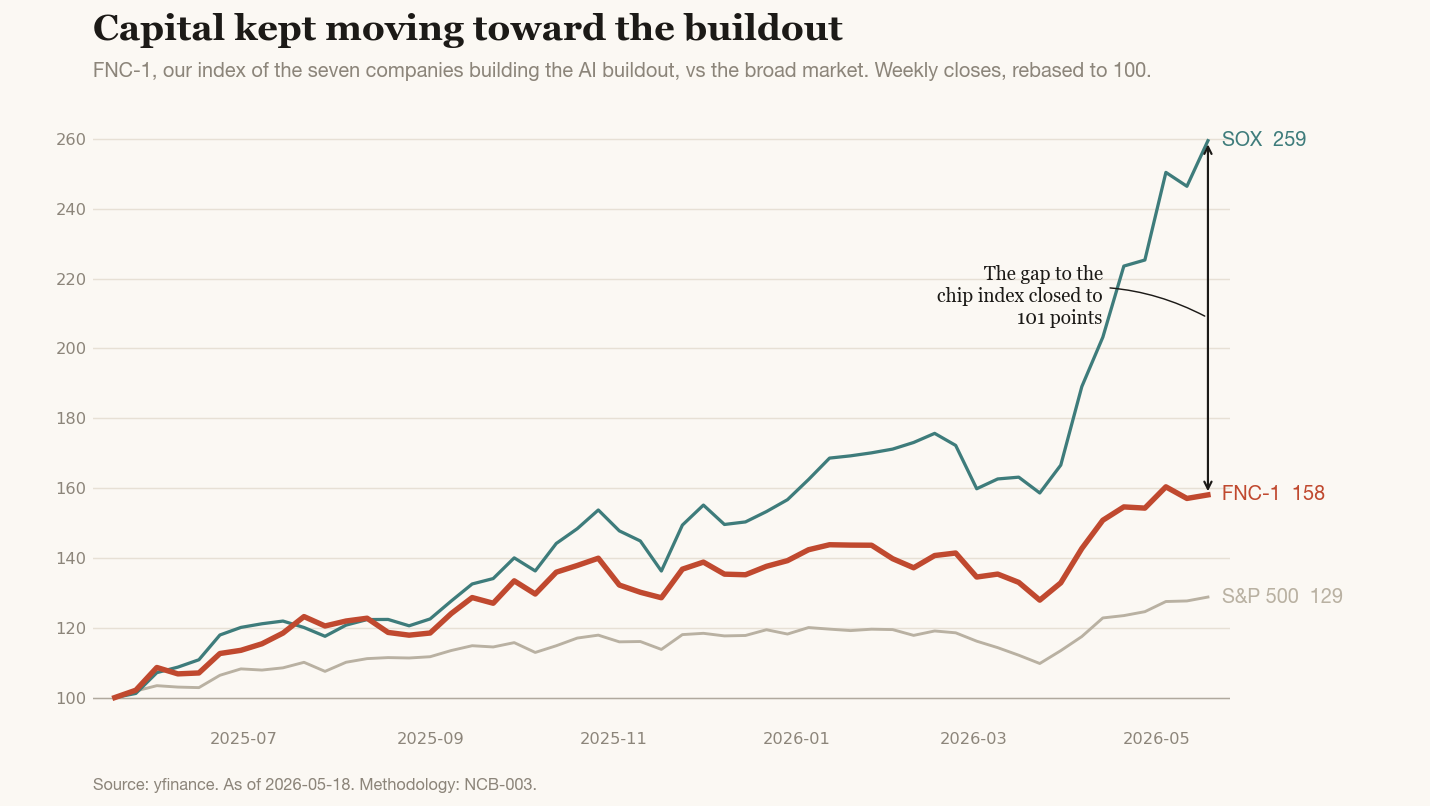
The instrument reads the aftermath. The FNC-1 Proxy reads 158.0, up 58% over the trailing twelve months. The Philadelphia Semiconductor Index, the benchmark for the chip complex, reads 259.5, and the S&P 500 128.8, each rebased to 100 a year ago. The chip index held its altitude through Nvidia's report while the broader basket did not.
What the headline number obscures is where the money is not going. FNC-1 spreads across four building blocks of the transition: compute, energy, the frontier labs, and biology. The chip index is compute alone. When semis hold and the diversified basket slips, the gap between them is the cleanest available picture of capital declining to broaden.
Nvidia is the whole tension in one name. The fundamentals confirmed everything the bulls have argued for two years, and the stock still could not rise on them, because there was no version of the print large enough to clear what was already priced in.
The gap between FNC-1 and the chip index stands near 101 points this week, wider than the roughly 90 points at the last reading. The basket is rebased each week in this version of the instrument, so the level matters less than the direction, and the direction is a chip complex pulling away from everything built around it.
II. Belief
The Belief Index reads 58 this week, up from 50 at the last reading. One component did almost all of the work.
III. Read
The capital data answered the question R-007 left open. The test was whether Nvidia's revenue was real and still accelerating, or whether the capex commitments were running ahead of the income that justifies them. The answer was unambiguous: $81.6 billion in a quarter, up 85%, margins intact. The falsification candidate we named two weeks ago, a Nvidia miss on revenue or gross margin, did not trigger. Nvidia answered the question, and the stock fell anyway.
The basket shows what a single name cannot. If you watched only Nvidia this week, you saw a confirmation. If you watched FNC-1 against the chip index, you saw capital pooling into compute while energy, the labs, and biology lagged. The four-substrate construction exists precisely to surface this. Capital is concentrating in compute, not broadening out of it, which is the opposite of the broadening thesis the cycle's optimists have leaned on.
The belief that moved this week was not whether the boom is real. It was whether it is about to go public. For months the dominant frame in this panel was the bubble question, whether conviction in “this is not a bubble” would hold. This week that question was crowded out by a different one. OpenAI's filing, two days after SpaceX put its own prospectus on file, repriced the IPO market by 45 points in a fortnight. The belief is no longer only that the buildout is real. It is that the buildout is heading for the public markets.
That is the shift worth holding. A confirmed leader the market would not reward, and a private cycle filing to become a public one, in the same week. Capital is concentrating while the exits open, and the two facts are connected: the companies with the clearest revenue are the ones being pulled toward listing, and the ones being pulled toward listing are where capital concentrates. The next test arrives with the disclosures. A confidential S-1 becomes a public one, and for the first time the audited numbers behind a trillion-dollar valuation meet daylight. Until then, belief is running ahead of what anyone can verify.
IV. What this measures, what it does not
The Belief Index is a snapshot of one venue's positioning, weighted by FP1's view of which markets matter for the AI transition. Individual components will be wrong. The aggregate, over time, is the signal.
The FNC-1 Proxy is a measurement instrument, not an investment vehicle. When the gap between the basket and the chip index widens or compresses, that is data. The Belief Index helps frame what the gap means.
Both instruments fail openly. NCB-003 specifies the falsification triggers, and the Nvidia test this week is an example of one resolving in the open.
V. Series record
This Reading formed part of the finite public application series. Current instrument state and later evidence updates live in the Radar and Register.
Full watchlist at fp1.ai/radar.
Sources
- yfinance / public market data, weekly closes through May 22, 2026
- NVIDIA Corporation, first-quarter fiscal 2027 results, May 20, 2026 (record revenue $81.6B, up 85% YoY; adjusted EPS $1.87)
- The Motley Fool, Nvidia earnings preview and hyperscaler capex, May 19, 2026
- Fortune, “OpenAI's trillion-dollar IPO filing”, May 22, 2026
- Wall Street Journal, CNBC, and Reuters reporting on OpenAI's confidential S-1 filing, May 22, 2026
- Investing.com, “The Trillion-Dollar IPO Test: SpaceX and OpenAI”, May 21, 2026
- Polymarket — OpenAI IPO by Dec 31, 2026
- Polymarket — GPT-6 released by Dec 31, 2026
- Polymarket — AI bubble burst by Dec 31, 2026
- Polymarket — OpenAI achieves AGI before 2027
- State of the Transition Reading R-007 (May 11, 2026) and Briefing B-001 (May 15, 2026)
Methodology: NCB-003: FNC-1, the Novacene Composite.